
Discover how Oqton’s Manufacturing OS is being used to decentralize manufacturing for the energy industry with foundational components that will enable the future of a digital warehouse at Formnext 2024, in a joint presentation with Baker Hughes on November 20th, at 11.30 am, on the Application Stage, hall 11.1.
In today’s fast-paced business environment, managing spare parts effectively is crucial for smooth, effective, and viable operations. Industries such as transportation and energy rely heavily on having replacement parts on hand to minimize downtime and ensure continuity. The challenge is to manage them cost-effectively. However, traditional warehousing strategies often involve significant upfront investments in manufacturing, inventory storage, and shipping.
Introducing digital warehouses for spare parts management
Digital warehouses offer a beneficial approach to spare parts management, leveraging the power of additive manufacturing (3D printing) to create components on demand. This innovative solution enables businesses to transform their spare parts strategies, achieving just-in-time manufacturing, reduced inventory costs, and lower carbon footprints.
Instead of an inventory of physical spare parts, you can have a digital catalogue, which is a collection of 3D models bundled with their requirements and manufacturing-related information.
The models can be digitized upfront, during maintenance or on demand. When a part is nearing the end of its lifetime you can request the product to be produced by the supplier of your choice and have it delivered to the closest facility – all of which avoids unnecessary downtime and cost.
On-demand spare parts for crucial business operations is an ideal application for additive manufacturing with its high variety of geometries, comparably smaller lot sizes and required short lead times.
This can, to a large extent, replace unnecessary physical warehouses.
Consequently, the concept of a digital warehouse, with all the opportunities it offers, is more relevant than ever.

Why switch to a digital warehouse?
Enable just-in-time and on-demand manufacturing
With digital warehouses, businesses can print spare parts in-house or request them externally as needed, eliminating the need for inventory storage and reducing the risk of obsolescence.
Reduce inventory costs
Typically, when ordering parts for your warehouse, you are required to meet a minimum order quantity. This often results in paying for parts you may never use, which also take up valuable warehouse space that incurs costs. By printing components on demand, companies can minimize inventory costs associated with traditional warehousing strategies.
Lower carbon footprint
Digital warehouses enable businesses to reduce material waste, energy consumption, and carbon emissions associated with traditional manufacturing and warehousing practices.
Improve supply chain resiliency
With digital warehouses, businesses can choose from a network of manufacturers located in different areas, reducing transportation costs and minimizing the risk of supply chain disruptions.
Reduce risk of obsolescence
Digital warehouses allow companies to save CAD files for obsolete parts, ensuring they can be manufactured as needed.
Reduce Delivery time
Being able to manufacture parts on demand will also shorten delivery times, as parts can be 3D printed locally instead of being shipped from distant locations around the world.

Challenges to adopting a digital warehouse
While digital warehouses offer numerous benefits, there are several challenges to consider when implementing this innovative solution
Knowledge barriers and risk aversion
Some industries may require education about the capabilities of additive manufacturing to produce compliant parts. The energy, oil & gas industry is particularly risk-averse due to its strict safety requirements. Liabilities are high, which has driven many in the industry to adopt a race-to-be-second attitude, adopting new technologies only once they have seen many other competitors use them.
With additive, there seems to be a change in mindset due to emerging connectivity and monitoring capabilities allowing stricter or more direct control over suppliers, some of which do not exist for conventional manufacturing techniques.
Data security
Digital warehouses must have robust data security systems in place to protect IP and prevent unauthorized access. A digital warehouse is more than a collection of 3D models. It can contain comprehensive information around manufacturing details or even patents which are part of the OEM’s IP and need to be protected.
Quality concerns
Ensuring consistent part quality is essential, particularly in highly regulated. In distributed manufacturing environments for these industries, remote monitoring needs to be in place to guarantee that a supplier is adhering to the instructions and standards their customers have put forth. Adhering to a common data framework is the first step toward ensuring consistent quality across suppliers.
Long qualification cycles
Some industries may traditionally require lengthy qualification cycles for additive parts, which can be time-consuming and costly. The same applies for conventional manufacturing which doesn’t offer the remote monitoring capabilities additive can provide.
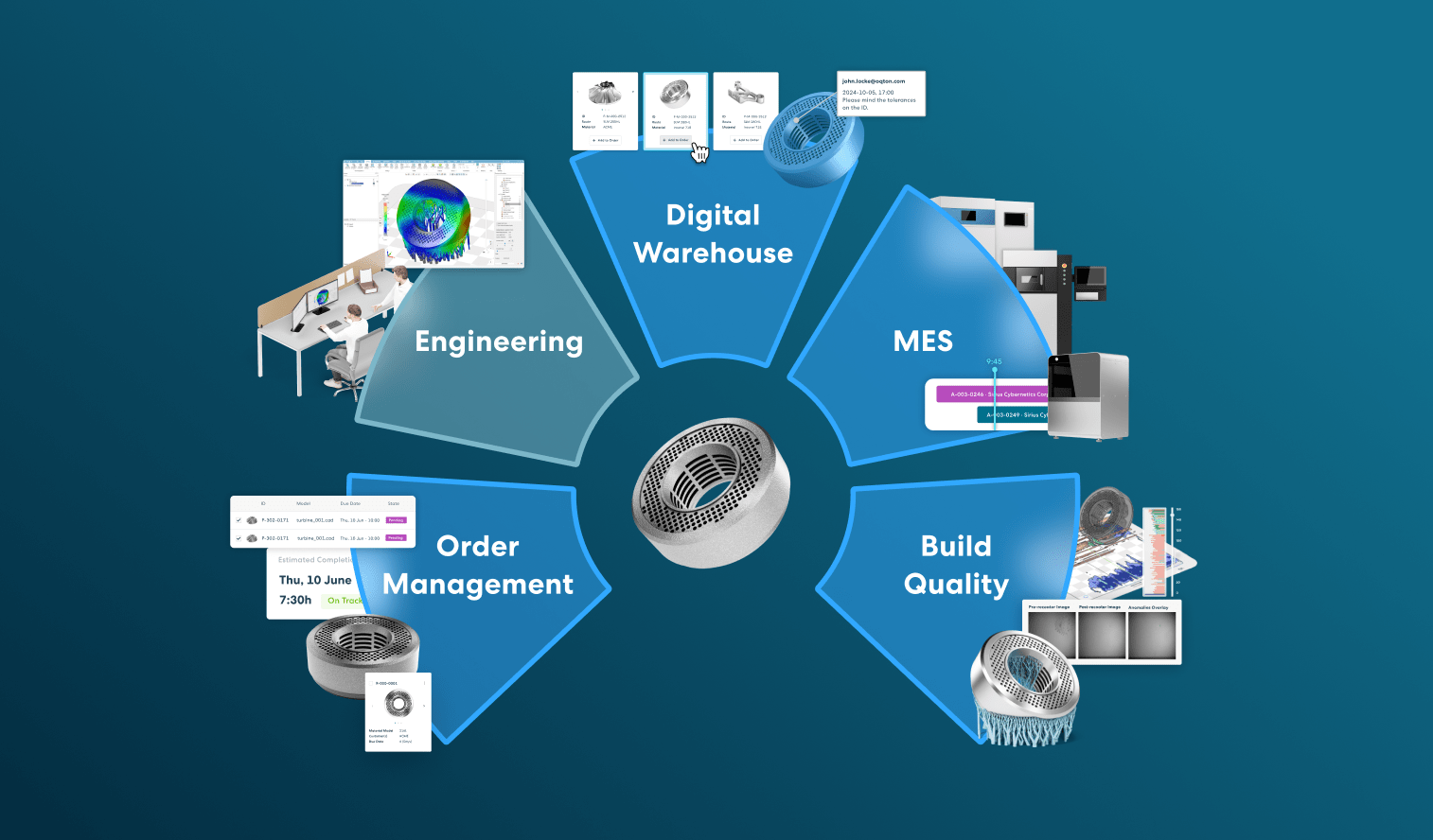
Software for digital warehousing
Digital warehouse software is critical for modern logistics and supply chain operations. It helps businesses efficiently track and manage inventory and improve order fulfillment processes. Digital warehouse software enables real-time visibility and control over digital parts and guarantees easy ordering.
The future of digital warehouses
Digital warehouses have the potential to unlock just-in-time manufacturing and release cash held up in maintaining physical inventories, but a successful adoption of the solution requires addressing knowledge barriers, ensuring data security, maintaining quality control, and meeting stringent qualification requirements. By overcoming these challenges, businesses can harness the full benefits of digital warehouses and revolutionize their spare parts management strategies.
As the industry continues to evolve, we can expect to see advancements in digital warehouse technology, including improved quality control processes, more robust data security systems, and greater connectivity between enterprise systems and additive manufacturing platforms.