
Are you facing challenges when integrating Additive Manufacturing into your existing production workflows?
Common pain points mentioned by professionals include:
- Manual process and traceability using paper-based traveler documents
- Limited remote access and control of your printers
- No automated reporting or dashboards to track operational performance
- High engineering costs spent on quoting and quality processes
- Scheduling of print jobs is inaccurate or not manageable
- Lack of seamless integration with your existing ordering systems
- Difficulty managing and tracing used materials
If managing or scaling your additive processes feels complex or inefficient, it may be time to consider an MES solution that was specifically designed for Additive Manufacturing. An Additive MES can help you streamline workflows, improve resource planning, and drive greater efficiency across your operations.
What is an MES?
A Manufacturing Execution System (MES) is a powerful workflow management software solution designed to oversee and control the entire production process.
An MES solution will provide you with a holistic view of manufacturing activities, including production order entry, planning and scheduling, machine monitoring, material tracking, and quality assurance.
Adding built-in seamless integration with other business systems such as Enterprise Resource Planning (ERP) or Customer Relation Management (CRM) solutions, an MES ensures that every aspect of the production chain is optimized and synchronized for maximum efficiency across the organization.
The Benefits of Implementing an MES for Additive Manufacturing
Implementing the right MES provides more than just visibility: it delivers immediate, measurable impact to operations.
Increased Operational Efficiency
Minimize downtime. Shift from firefighting to optimization with real-time job coordination, resource balancing, and reduction in non-value-added tasks.
Reduced Production Costs
Reduce material waste, accelerate turnaround time, and eliminate redundant work steps. Get more from your existing printer fleet and team.
Superior Decision-Making
Gain end-to-end workflow visibility with centralized KPIs. Make data-backed decisions based on cumulative learning from each part, machine, and operator.
Enhanced Product Quality
Rely on automated QA checks, digital part records, and dynamic compliance reporting. Build consistent, certifiable parts with repeatable success.
Operational Scalability
Add printers quickly. Ramp up locations. Integrate with new enterprise platforms. A flexible MES grows with you, supporting enterprise-wide AM deployment.
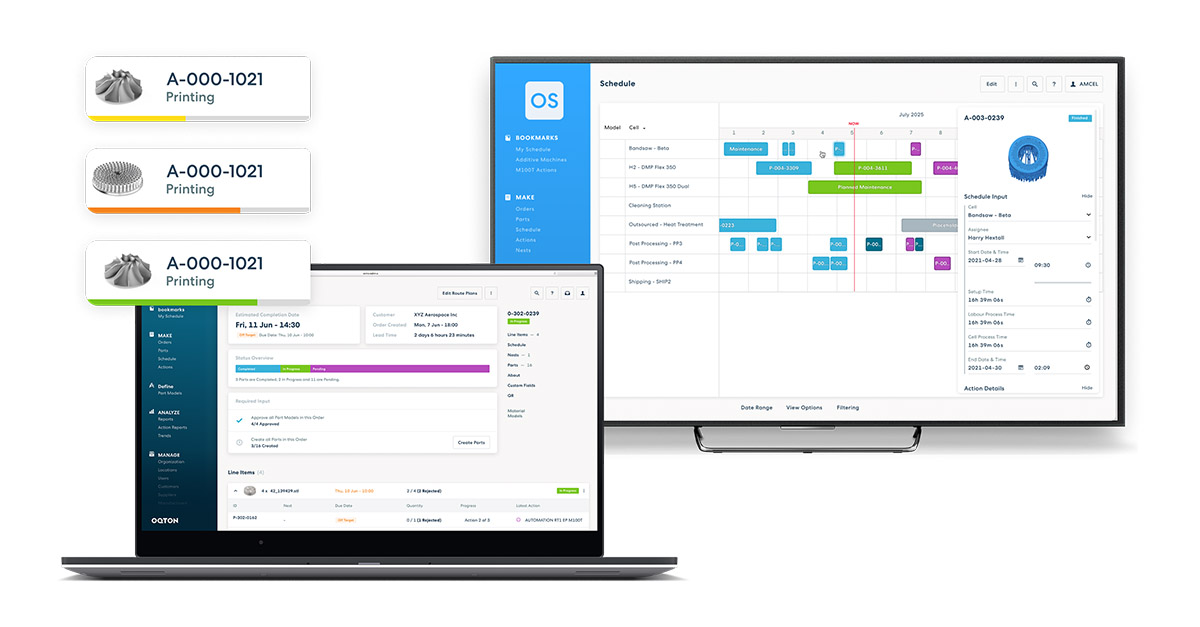
Key Features of an Effective MES for Additive Manufacturing
An MES designed for additive manufacturing offers a suite of features that significantly enhance operational efficiency and product quality. A closer look at these capabilities reveals why they are indispensable:
A purpose-built Additive MES empowers you to automate workflows, ensure traceability, and maintain manufacturing compliance—while leveraging real-time anomaly detection powered by AI to safeguard quality.
Workflow Automation
Define certified routes, automatically assign work instructions, and maintain repeatable execution across jobs. Standardize key steps to reduce manual input and enforce consistency for every build.
Real-Time Planning & Smart Scheduling
Coordinate production across locations, printers, and technologies. Optimize utilization by dynamically adjusting schedules based on actual capacity, material availability, or job priorities, while keeping your operation agile and efficient.
Full Part & Material Traceability
Track every element of the production lifecycle: from CAD version, material lot, and machine parameters to final part serialization. Built-in traceability ensures regulatory compliance and prevents costly rework or audit gaps.
Quality Control & Compliance Assurance
Centralize and automate your QA processes, including monitoring, pass/fail checks, and data collection. Leverage AI-based real-time anomaly detection to identify deviations before parts move into costly post-processing – giving you immediate insights to protect part quality and reduce risk.
Why Additive Manufacturing Requires a Specialized MES
Unlike conventional manufacturing, 3D printing introduces highly complex digital workflows, including:
- File preparation, version control, and slicing
- Automated or manual support generation
- Printer-specific process parameters
- Serial tracking for parts in regulated industries
- Layered traceability through post-processing stages
Generic MES solutions fall short when materials, machines, and parameters vary job by job. For AM, you need a platform that accelerates throughput without sacrificing quality or control.
Who is this MES for?
An MES for AM is designed to support companies of all sizes and industries that would like to adopt additive workflows.
Whether you’re a service bureau scaling operations or a large-scale manufacturer managing fleet operations across multiple sites, your solution should fit seamlessly into your existing ecosystem.
Customers who are successful with AM in all sectors use MES for AM solutions to bring automation, visibility, and compliance to their manufacturing environments.
What criteria matter when choosing your next MES for Additive Manufacturing, and how can AI help you to optimize your operation?
Starting with Additive Manufacturing or trying to add Additive Manufacturing to your existing operation? A dedicated Additive MES is essential to improve your experience efficiency, quality, and control.
Adopting Additive does not need to be complicated or involve large investments.
Whether you are a large enterprise, an OEM, or operate a small business, a dedicated fit to your need management execution system (MES) is crucial to staying competitive.
Selecting the Right MES for Additive Manufacturing:
What to Look For?
When coming to choose the solution that you need consider the following:
Is It Built for Additive from the Ground Up?
Supports materials reuse, print job (re-)routing, and printer-specific process steps.
Does It Seamlessly Integrate with Enterprise Tools?
Can you connect ERP, CRM, PLM, QMS, and even shop floor sensors for centralized insight?
How Easily Can It Scale?
Can you onboard new printer tech, factory locations, and user teams while keeping workflows secure and centralized?
Will Your Team Actually Use It?
An intuitive interface fuels rapid onboarding and high user adoption, an essential ingredient for success.
Does It Embrace Artificial Intelligence?
The future of MES is predictive, adaptive, and continually optimized. Make sure the system you choose uses AI to drive value where it matters.
What ROI Can You Expect and Prove?
Track productivity gains, scrap reduction, higher throughput, or faster time-to-quote – even before full-scale rollout.
Final Thoughts: Unlock the Full Potential of Your AM Process
Achieving true production readiness in additive manufacturing requires more than just high-end machines—it demands smart software that provides automation and quality over every stage of production, that transform your 3D printing operations from fragmented and manual to connected and intelligent.
Make sure your MES is ready to help you adopt and integrate Additive Manufacturing.
If you are ready to streamline your solutions and looking for your partner to help you get there, the Oqton team will gladly help you with any farther questions or concerns you may have over implementing your Additive MES.
See more information on how we can help you stream your workflow better here.