
Abstract
Additive manufacturing enables highly efficient, application-specific components with complex geometries, including thin walls, massive regions, and low-angle overhangs that create challenging and variable thermal conditions during the build process. Static, globally applied laser parameters often cannot adapt to these conditions, leading to poor surface quality, insufficient material properties, reduced part performance, earlier degradation, and increased risk of premature failure. MeltControl addresses these limitations by combining adaptive hatching strategies for down-facing regions with locally optimized laser parameters on individual vector segments and micro-waiting times between hatches. These adaptations are derived from a multi-level, physics-based thermal simulation. The approach builds on existing validated process parameters, adjusting them only where necessary within a pre-defined allowable operational window, while being based on a low number of optimization variables, which simplifies calibration and improves transferability between applications. In practice, MeltControl significantly improves surface quality for low-angle overhangs and thermally critical regions while maintaining feasible computation times, even for large industrial build jobs.
Compared to other manufacturing techniques, additive manufacturing enables unparalleled freedom of design. This leads to extremely complex shapes where a single component combines paper-thin walls with bulky regions. Low unsupported overhang angles as well as macroscopic heat build-up, especially driven by multi-laser systems, introduce additional thermal complexity to the process. This variety of influences leads to highly variable thermal boundary conditions during the build process. It is clear that a single static parameter cannot provide optimal results for all possible combinations of these conditions. Since hatching patterns and vector sequence play an important role in thermal development, it is virtually impossible to manually assign individual parameters to achieve desired optimal part quality.
Unadapted and static laser control applied to such a dynamic process is bound to result in suboptimal process results such as poor surface finish and insufficient material properties. Approaches such as individual and automatically assigned parameters that depend only on the angle of an overhang fail to capture the difference between a thin wall printed at 20° and a cooling channel inside a massive block. Thermal conditions, however, vary greatly between these two cases even if the macro thermal development is neglected.
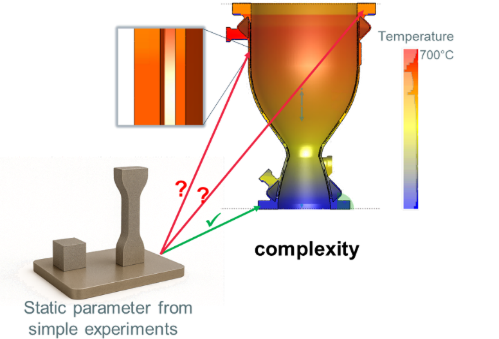
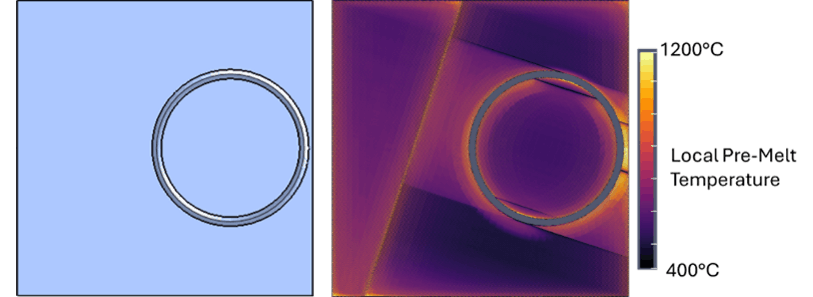
MeltControl combines state-of-the-art simulation models with pre-calculated adaptive hatching strategies for down-facing regions in order to automatically optimize local laser parameters in individual vector segments. Thermal development is predicted by multi-level simulation, and parameters are optimized based on physical principles. The physics-based approach reduces the number of optimization parameters, which in turn greatly simplifies calibration and ensures transferability.
MeltControl Concept & Approach
MeltControl is based on Oqton’s decade-long experience in process control and simulation for additive manufacturing. The underlying principle is to use an existing validated static parameter and locally adapt it only where necessary within a pre-defined allowable operational window. MeltControl combines your existing process IP with the thermal reality of complex parts and enables you to use the full potential of AM.
Hatching techniques
For extreme overhangs and arch-like structures, new hatching techniques such as “anchor motions”, “bridge motions” and re-ordering were introduced to the slicer algorithm. Those approaches automatically identify regions where the standard hatch orientation and sequence are non-optimal and introduce dedicated low-angle motions.
The hatching techniques are applied before simulation-based parameter optimization, in which they are explicitly considered.
Simulation-based optimization
During the simulation-based process optimization, MeltControl predicts the local thermal development during the printing process on a vector level. Influences such as distance to the powder in all spatial directions and the exact vector sequences are derived from the slice data. Material-individual properties and simulation-related parameters are taken from Oqton’s existing simulation database or can be provided as a user input.
The macro temperature build-up over the whole print of the component can be integrated via a dedicated FE simulation. Even though parameters are by default optimized for multiple segments per millimeter, calculation time ranges between 2%-10% of the total printing time depending on the computation hardware and MeltControl settings.
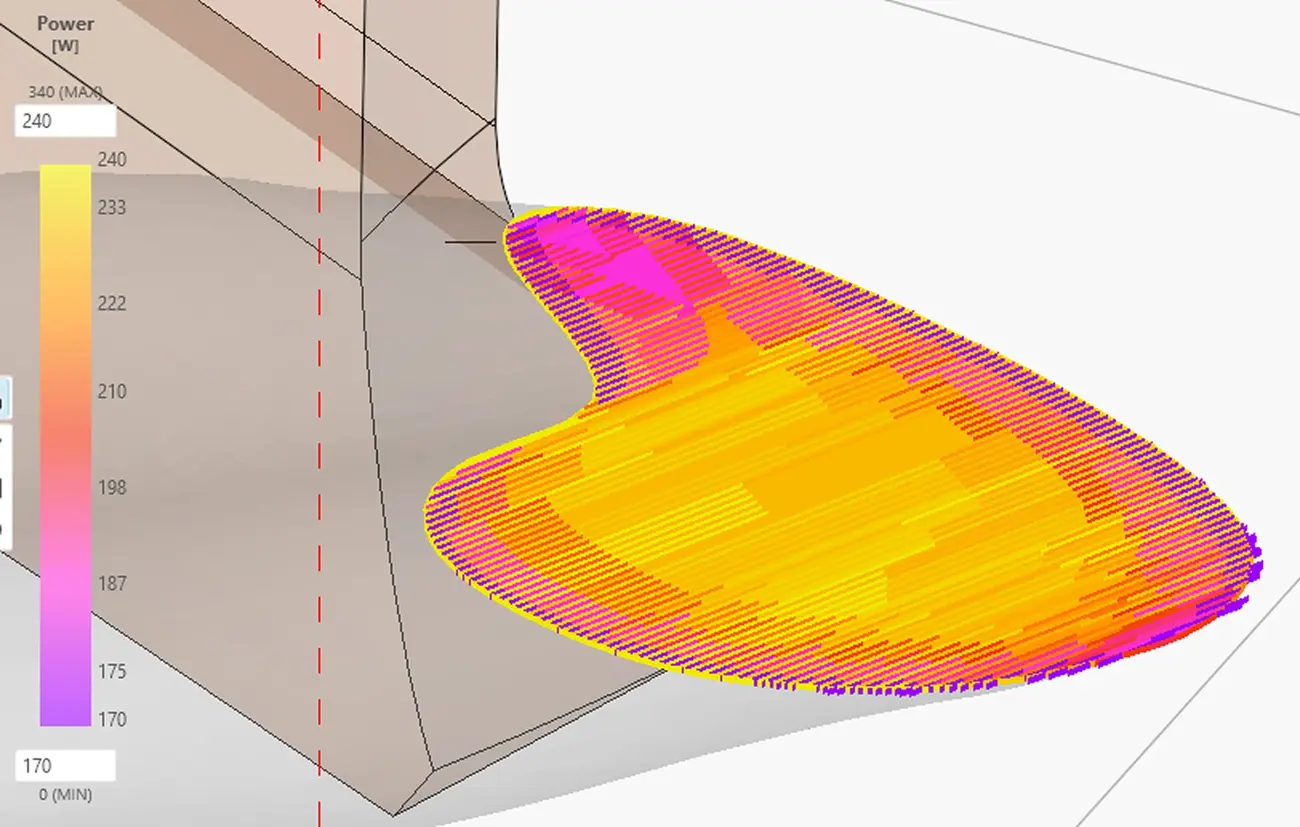
During optimization, the laser power is adapted within defined ranges wherever the simulated thermal condition differs too much from the standard one. In case the local thermal build-up is too high, micro delays are introduced.
As was mentioned before, the physics-based approach reduced the amount of necessary parameters significantly, reducing the number of optimization parameters to 5, including the maximum and minimum power modulation factors.
Down-facing parameters can be fully optimized without the need for a specific parameter up front, overall simplifying the topic of parameter development.
Workflow and usage
Before using MeltControl, an initial calibration is recommended. Calibrate the printer and material-dependent optimization parameters by printing small DOEs to account for the material-specific behavior
After the initial calibration of MeltControl, the workflow for preparing each new print job is simple:
- Place anchoring supports in the lowest points and regions.
- Based on the calibration DOE results, place minimal support structures in regions that have angles lower than typically achievable for the material.
- Different MeltControl processes can be applied to specific dedicated regions of the part via 3DXpert-technologies and virtual volumes if desired.
- The standard slicing operation is executed.
- Run MeltControl tool.
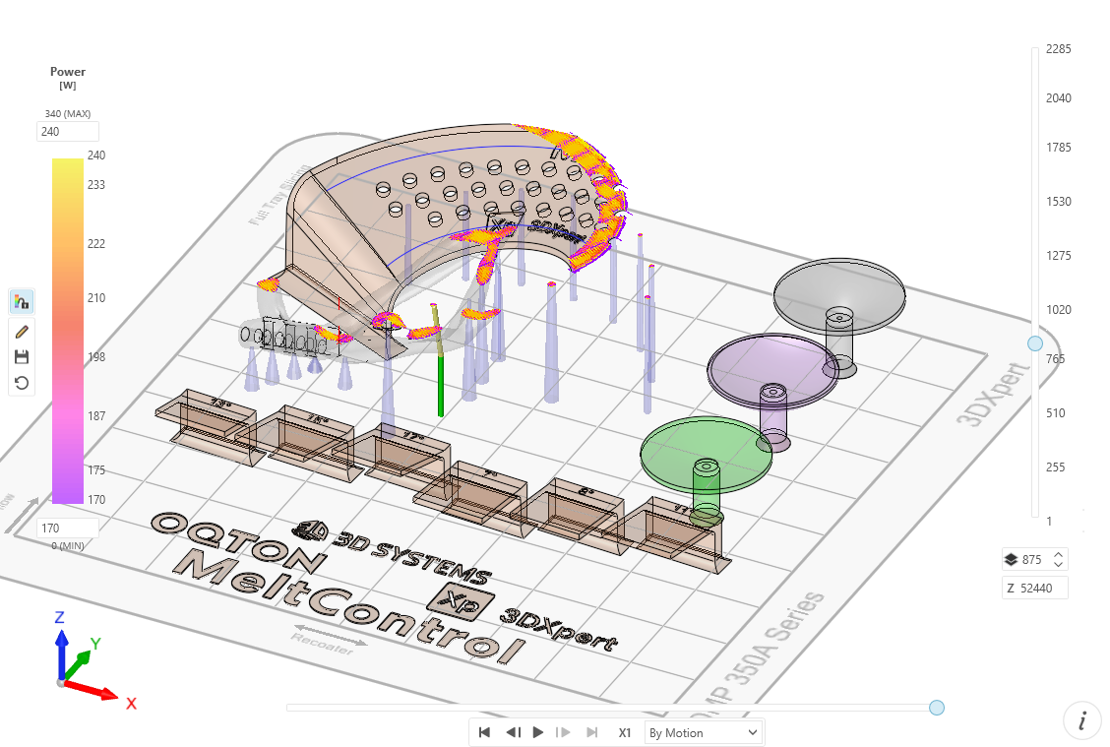
- The optimized laser powers are visualized in the slice viewer together with laser-off motions for micro-delay implementation.
- Printing files can be exported or sent to machines.
Results
Surface quality, especially for low-angle overhangs and in case of significant thermal overheating, is drastically improved with MeltControl.
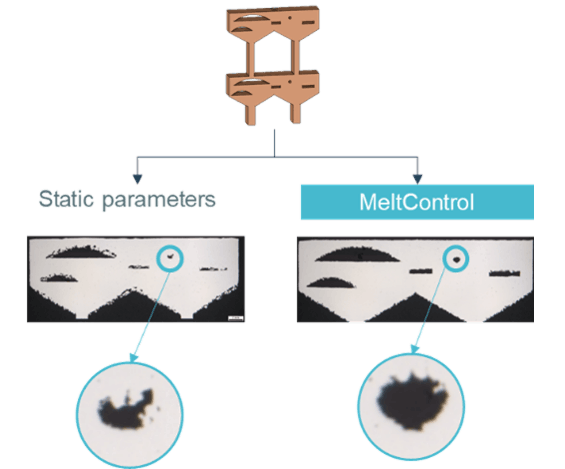
The following demo job takes only 30 minutes to compute and 15 hours to print on a single-head machine without relevant additional delays on a standard mobile workstation. The central spiral piece has an overhang angle of 17° and could not be printed using the static parameter. The lowest angle of the fingers was 7°.
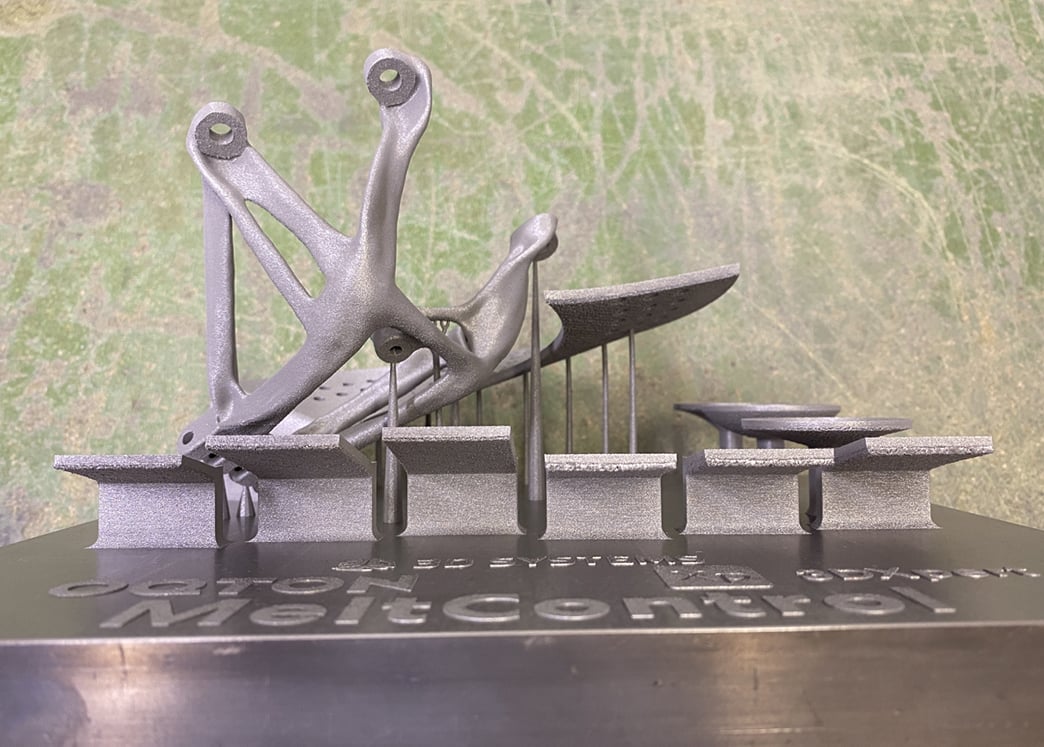
It is possible to reduce the calculation time when applying the optimization locally.
Adaptive Process Control for Additive Manufacturing
Conventional hatching strategies, depending only on overhang angles, fail to distinguish between geometrically and thermally different features like thin walls and cooling channels in bulky regions, leading to suboptimal process outcomes.
Oqton’s MeltControl concept relies on simulation-based process control and uses existing, validated parameters as a baseline, adapting them locally based on predicted thermal behavior. New hatching techniques such as anchor motions, bridge motions, and dedicated low-angle hatch reordering are automatically applied in regions where standard hatch orientation and sequence are non-optimal, and these techniques are explicitly considered in the subsequent simulation-based optimization.
During optimization, the system evaluates thermal boundary conditions using slice data, material properties, and optional macro thermal coupling via FE simulation. Laser power is adjusted within allowable predefined ranges when local thermal conditions deviate from the standard case, and micro delays are introduced where necessary to mitigate thermal buildup. A streamlined workflow integrates MeltControl into standard slicing and job preparation, enabling application of different MeltControl processes to various part regions and visualization of optimized laser powers and delay motions.
Results shown in the article demonstrate drastically improved surface quality and support reduction in low-angle overhangs, with computation times in the order of 2–10% of total print time, depending on hardware and settings. A demo job with a 17° spiral overhang and “finger” features with overhangs down to 7°, previously unprintable reasonably with static parameters, can be produced successfully, and further computation time reductions are possible by excluding non-critical regions from optimization.
Authors: John Schlasche & Christian Kober